

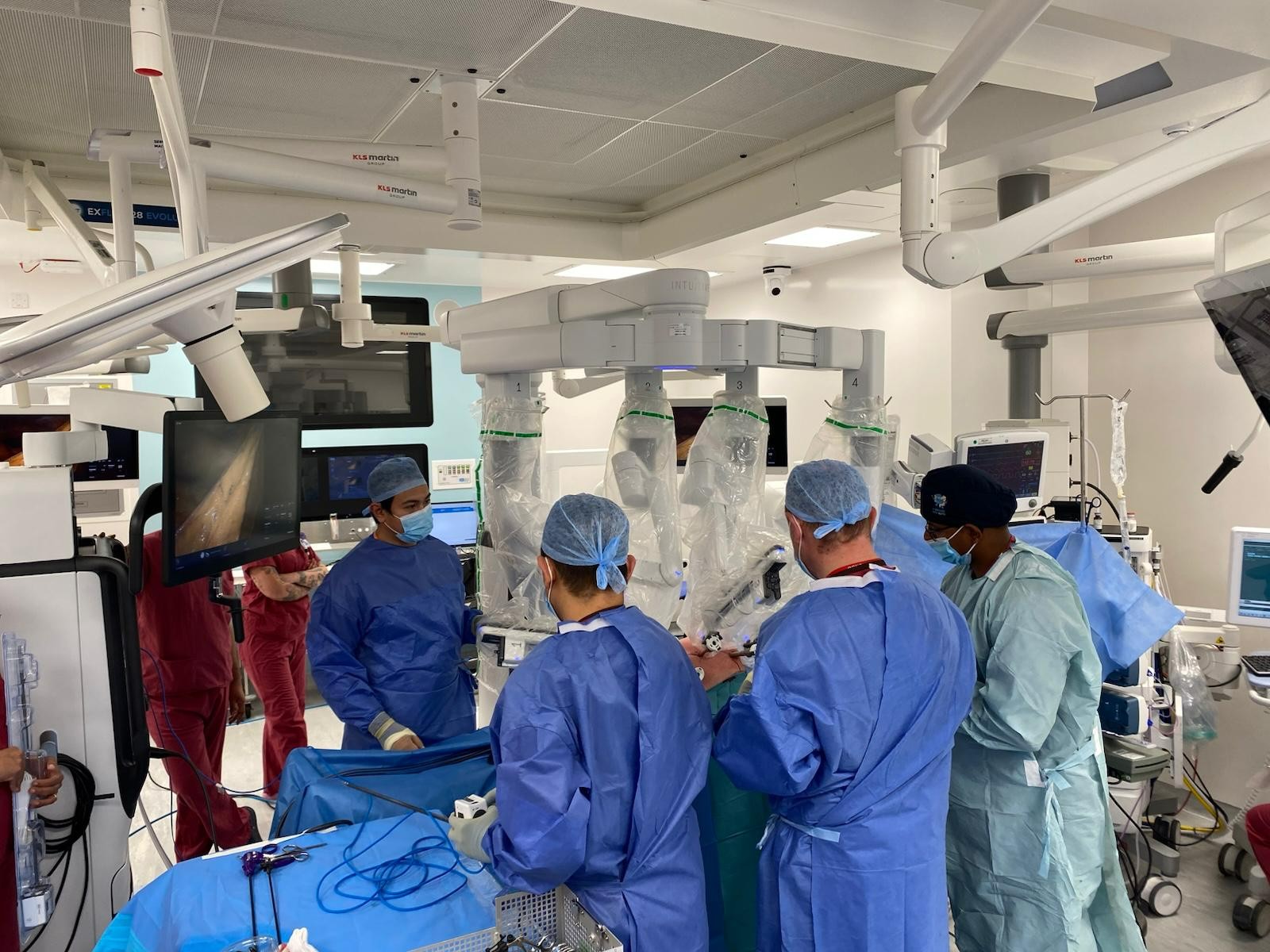
Patients in Hertfordshire will be among the first in the UK to benefit from the most advanced robotic surgery technology ever used by the NHS – which will speed up recovery times for cancer surgery, increase the number of operations available and cut waiting lists.
The state-of-the art platform is designed to minimise tissue damage from surgery – by allowing surgeons to feel more resistance as they operate and apply significantly less force compared to previous models.
Operating with higher levels of precision will cause less tissue trauma, and fewer complications meaning patients should recover faster from their operations and be able to return to their normal life as quickly as possible.
Some patients can go home just 24 hours after complex surgery for conditions like bowel cancer – and are then monitored remotely through the Trust’s Virtual Hospital using wearable technology to monitor their health. But it’s the recovery time which remains the major worry for patients.
“What patients care most about is when they’ll be able to get back to normal after surgery,” said Dr Vanash Patel, a colorectal surgeon and leader of the Trust’s robotic programme.
“The fatigue and tiredness from an operation for can last up to two months in some cases, and that creates uncertainty and stress for many patients who worry about when they can get back to work and effectively restart their lives again.
“This new system will support faster patient recovery, increase the number of operations we carry out and lead to fewer complications. That’s fantastic news for patients and the surgeons caring for them.”
West Herts is home to one of the most advanced robotic programmes in the UK and its latest investment underlines its commitment to innovation and supporting the government’s 10 Year Plan.
The benefits of the Intuitive DV5 robot to patients and surgeons include:
- It has 10,000 times more computing power than before, which means surgeons will be to operate more efficiently and help provide better outcomes for patients.
- Faster operations and greater theatre efficiency will mean West Herts can treat more patients – so could lead to another 200 operations a year.
- Improved high-definition, 3D vision system. This gives surgeons a crystal-clear, magnified view of the surgical site. This leads to better depth perception and greater detail, aiding in delicate dissections and suturing during complex surgeries.
- The ability for surgeons anywhere in the world to view an operation – and offer specialist guidance and expertise in a particularly rare or complex case. This means patients will benefit from a network of world leading experts.
- Training – the new system will allow surgeons to walk trainees through operations and show them what they’re doing and why. The dual console controls means a trainee can ‘sit in’ with the surgeon and be guided through procedures.
- The system will be used for bowel cancer, kidney cancer, gall bladder and hernia surgery.
The Trust, which serves a population of over 600,000, is also believed to be the first in the country to be investing in a robotic surgery system solely for its Emergency Department (ED).
The innovation will help ensure patients for example who are treated in ED for bowel cancer at short notice can benefit from the same robotic surgery as those who have diagnosed early, with a planned schedule of treatment.
Meanwhile, the arrival of the DV5 robot at Watford General will free up an existing system to be moved to St Albans City Hospital to treat day cases like hernias and gall bladder removals in high volumes.
Dr Patel added: “We’re proud to have created a centre of excellence in robotics surgery and have welcomed surgeons from all over Europe, USA and India to see what we do here at West Herts.
“The technology is vital but is only one part of the story. Our focus has been on training, upskilling and culture change – so we’re working in a joined-up way across divisions to help our patients get home and recover as fast as possible.
“This latest investment underlines once more our commitment to innovation and delivering the highest quality care for our patients.”